
I wrote a blog post with Surbhi Kesar for the Institute for New Economic Thinking on the Economics discipline’s lack of capacity to understand racial inequalities, based on survey data.
 Ingrid's website
I wrote a blog post with Surbhi Kesar for the Institute for New Economic Thinking on the Economics discipline’s lack of capacity to understand racial inequalities, based on survey data.
I wrote an article on how COVID-19 exposes weaknesses in the dominant Economics narrative, and how heterodox economics offer important alternatives, with Carolina Alves for the Review of Agrarian Studies. Here’s the abstract:
In this article, we argue that societies’ unpreparedness and inadequate responses to the Covid-19 pandemic expose weaknesses in the foundations of the dominant economic paradigm. We document how economics came to disembed itself from broader societal analysis and how this has influenced public policy in problematic ways, leading to privileging of efficiency over resilience. We then go a step further to consider the role of economic evidence in public policy more generally. Furthermore, we demonstrate how heterodox economics can enrich our understandings of our economies’ weaknesses and of how to build a more resilient and just economy. We conclude that we need an explanation of the crisis that is capable of seeing the economy as more than just markets and as embedded in society; one that is capable of linking the causes and consequences of the pandemic to our systems of production and distribution.
Read the full paper.

Along with D-Econ, I’ll be hosing a workshop at Exploring Economics’ Summer Academy August 10-16th 2020 on Critical Development Economics/Decolonizing Economics. Register for the workshop here.
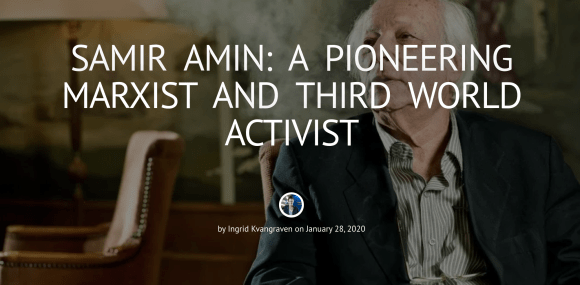
I recently had the pleasure of contributing a blog post to the excellent blog Progress in Political Economy (PPE), which is based at the University of Sydney’s Political Economy department. I wrote about Samir Amin’s legacy, based on my recent Legacy piece in Development and Change. Check it out here.
I had the honor of writing a legacy piece on Samir Amin for Development and Change this year. It will be a part of the 2020 Forum issue, but is already available for download.

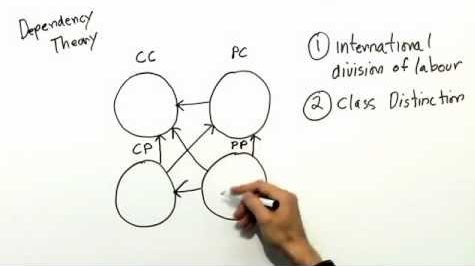
In this article in The Mint, I explore the relevance of dependency theory/ies today, along with Farwa Sial and Carolina Alves. We also identify some common critiques of dependency theory and argue that these are rooted in misunderstandings about the theories.
 I have a new working paper with Carolina Alves in the ESRC GPID Research Network Working Paper series.
Read a short blog post about the project or a long one.
Download the working paper here.
Carolina Alves and I unpack misunderstandings about Heterodox Economics in our recent blog post on Developing Economics:

By Ingrid Harvold Kvangraven and Carolina Alves
“Economics is unique among the social sciences in having a single monolithic mainstream, which is either unaware of or actively hostile to alternative approaches.” (John King 2013: 17)
What does heterodox economics mean? Is the label helpful or harmful? Being outside of the mainstream of the Economics discipline, the way we position ourselves may be particularly important. For this reason, many around us shun the use of the term “heterodox” and advise against using it. However, we believe the reluctance to use the term stems in part from misunderstandings of (and sometimes disagreement over) what the term means and perhaps disagreements over strategies for how to change the discipline.
In other words, this is an important debate about both identification and strategy. In this blog, we wish to raise the issue in heterodox and mainstream circles, by busting a few common myths about Heterodox Economics – mostly stemming from the orthodoxy. This is a small part of a larger project on defining heterodox economics.
Read more here.
The post has also been re-published by Union for Radical Political Economics and the Monthly Review. It has also been translated to Spanish (see here).
In June 2018, the Interdisciplinary Global Development Centre was launched (my new employer). During the launch, I held a presentation of my project “Heterodox Development Economics” and gave some remarks. See the promo video from the event below.
You can read more about the launch here and about the Heterodox Development Economics project here.
Carolina Alves (University of Cambridge) and I wrote some thoughts on the way Marx has been celebrated this year, why he appears to be so polarizing, and the effects on the marginalization of Marx in Economics. Check it out.
 Ingrid's website