Categories
Imperialism International Financial Subordination Marx Publications

The Money Fetish and Empire: “Liberation Day” and the Roots of Dollar Dominance (new article)

This article is a part of a roundtable on imperialism in the journal Spectre.

The introduction:


SINCE THE BEGINNING
 of US President Donald Trump’s second term in 2025, the political nature of money has been evident to anyone following economic and financial news. Any loss in value of the US Dollar (USD) tends to be met by scaremongering among Western pundits about the decline of the dollar as world money, and therefore also the decline of US hegemony.

The scaremongering is, then, in turn met with a counterbarrage of opinion pieces outlining all the ways in which the dollar is still dominant as a means of payment and store of value. What is strikingly absent in these discussions is an understanding of the dominance of the USD as closely connected not simply to the US dollar’s use and the institutions that support it, but also to global value relations.

Via the Marxist critique of political economy, this essay seeks to expose the limitations of dominant framings which see the potentially imminent fall of the dollar. This is especially important for grasping today’s moment of flux and the extent to which dedollarization, increased trading in Yuan, and sell-offs of the dollar constitute a paradigm shift for the contemporary monetary order.

Rather than focusing on either the role of trust in the dollar on the one hand or China’s strategy to internationalize the renminbi on the other, this essay links the development of a global international division of labor, and the power relations it is characterized by, with the dominance of world money. This leads to a very different way of understanding the current moment than that of mainstream commentators.

To do this, the essay starts by laying out how economists and other social scientists approach money through a kind of money fetish, then it moves to discussing what a Marxist understanding of money in capitalism entails. It then discusses what this means for understanding world money historically, and finally, the situation today is laid out, contrasting it with the most dominant characterizations by academics and journalists.

Read the full article here. If you have trouble accessing, check my ResearchGate.

Categories
Publications Economic Development Decolonizing Economics Marx Imperialism Methodology

Inverted Eurocentrism: The Consumption of Decolonization in the Global North and a Radical Decolonization Agenda (new article)

I have a new article out in Development and Change‘s new Forum on decoloniality. The abstract:

In the Global North and elite spaces in the Global South, the concepts of Eurocentrism and decolonization have come to be associated primarily with identity and location rather than with capitalism and political economy. This article argues that the reason for this can be traced to what Samir Amin calls ‘inverted Eurocentrism’, which entails a romanticization of specific identities or social formations in the Global South that tends to accompany Eurocentric ideology. This has become the dominant discourse on decolonization, leading to the displacement of broader, more radical decolonization efforts. Moreover, this discourse reflects a partial engagement with the original Modernity-Coloniality-Decoloniality (MCD) debates in Latin America that it claims as its origin. The article argues that a radical decolonization agenda entails the critique of political economy and it evaluates the extent to which the original MCD tradition reflects such an agenda. It shows that, despite allowing for a more critical understanding of knowledge, decolonization and capitalism than today’s dominant decolonial strand, the original MCD tradition is nonetheless limited by its departure from the critique of political economy. Finally, the implications of the dominant understanding of decolonization for universities and beyond are considered and the article concludes that this understanding of decolonization hinders a structural critique of capitalism and imperialism.

Read the full article here – it’s open access.

Categories
Blog Decolonizing Economics Dependency theory Economic Development Heterodox Economics Imperialism Marx

Beyond Eurocentrism (essay)

I recently wrote an essay about Samir Amin for the popular magainze, Aeon. In it, I go through what I think are major lessons from Samir Amin that can help us understand imperialism, Eurocentrism, uneven development, and ideology better. I contrast his structural and materialist analysis of capitalism and imperialism with the culturalist views of Edward Said, as Said has received much more attention in both academia and in the public sphere. Read the essay here.

Read a Spanish translation of the article here (Letras Libres) and a Persian translation here.

Categories
Africa Book review Decolonizing Economics Imperialism Marx Publications

Colonial legacies and racial hierarchies in the global economy (review essay)

I had the privelege of publishing a review essay of two books in the most recent issue of Race and Class (2022). I review the important contributions and radical potential of Adom Getachew’s Worldmaking after Empire (2019) and Franklin Obeng-Odoom’s Property, Institutions, and Social Stratification in Africa (2020), and outline some ways in which their analyses and frameworks could be expanded along anti-colonial Marxist lines.

Read the full review here.

Categories
Africa Dependency theory Economic Development Heterodox Economics Imperialism Marx Publications

Samir Amin and Beyond: Radical Political Economy, Dependence and Delinking Today (Special Issue)

Along with Maria Dyveke Styve and Ushehwedu Kufakurinani, I edited a special issue in Review of African Political Economy on Samir Amin’s work and its relevance for contemporary problems.

You can read our introductory editorial here: Samir Amin and beyond: the enduring relevance of Amin’s approach to political economy. We also wrote a blog post about the issue that you can find here.

Categories
Book review Critique of Mainstream Economics Marx

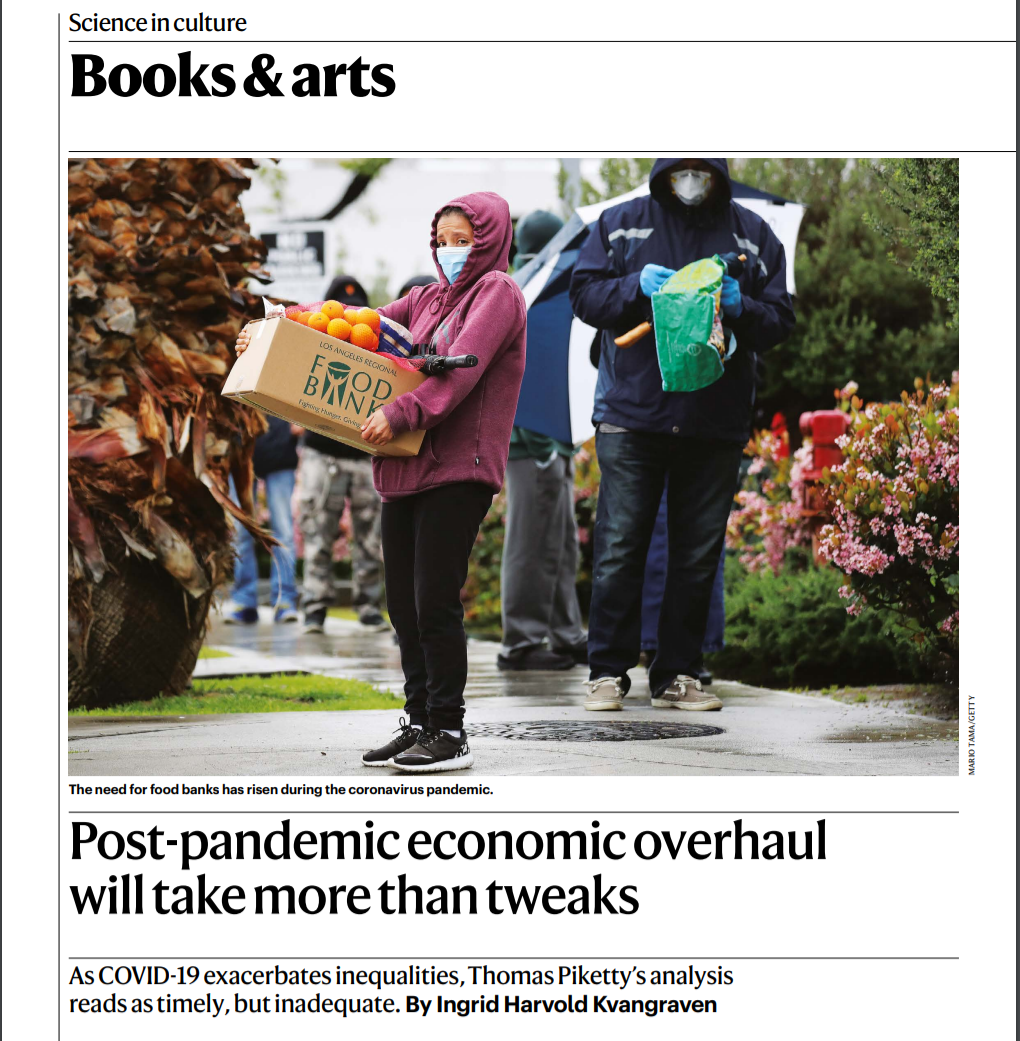
Review of Piketty’s “Capital and Ideology”

Screenshot 2020-05-03 at 13.32.12

I recently wrote a review of Thomas Piketty’s Capital and Ideology for Nature. Read the full review.

Categories
Dependency theory Economic Development Heterodox Economics Marx Publications

Samir Amin: A Pioneering Marxist and Third World Activist (new article)

I had the honor of writing a legacy piece on Samir Amin for Development and Change this year. It will be a part of the 2020 Forum issue, but is already available for download.

Screenshot 2019-12-08 at 10.51.53.png

Categories
Blog Heterodox Economics Marx

Some thoughts on Marx’s 200th birthday

Carolina Alves (University of Cambridge) and I wrote some thoughts on the way Marx has been celebrated this year, why he appears to be so polarizing, and the effects on the marginalization of Marx in Economics. Check it out.

Categories
Book review Heterodox Economics Marx

Book Review of Capitalism – Competition, Conflict, Crises (Norwegian)

I recently reviewed Anwar Shaikh’s Capitalism – Competition, Conflict, Crises (2016) for the Norwegian journal Agora (see/buy the issue here). The review has also been published online on Manifest Analyse.

Categories
Book review Heterodox Economics In the media Klassekampen Marx Norway-related Op-ed

Debate with Norwegian Marxist

Following my book review of Anwar Shaikh’s Capitalism – Competition, Conflict, Crises, I ended up in a debate with a Norwegian philosopher (and Marxist) about Shaikh’s labor theory of value. The debate took place in the Norwegian newspaper Klassekampen.

Here is the exchange:
Anwar Shaikh versus seriøs teori (Jørgen Sandemose, May 30th 2016)
Seriøs teori (Ingrid Harvold Kvangraven, June 1st 2016)
Om en uholdbar «verditeori» (Jørgen Sandemose, June 8th, 2016)
På tide å lese boka? (Ingrid Harvold Kvangraven, June 14th 2016)
Den siste replikken (Jørgen Sandemose, June 15th, 2016)