
Categories
Blog Decolonizing Economics Dependency theory Economic Development Publications

Inverted Eurocentrism: The Consumption of Decolonization in the Global North (new blog post)

At a moment when the United States has recently kidnapped the Venezuelan leader Nicolás Maduro, assassinated the Iranian supreme leader Ali Hosseini Khamenei, is plotting regime change in Cuba, and is continuing to support genocide and colonial oppression in Palestine, the question of how to understand empire, capitalism, and possibilities for resistance is as pressing as ever. In a new article, I argue that any radical decolonization agenda must be aligned with critique of and resistance to contemporary oppression. I also posit that the most dominant form of decolonial theory – the one that is now pervasive across global North universities as well as many institutions across the global South – does not lend itself to such radical critique and resistance.

Today, “Eurocentrism” tends to be equated with the study of Europe or studies by Europeans, and the process of intellectual decolonization tends to be equated with elevating indigenous or global South voices and perspectives as well as the inclusion of case studies from the global South. When liberal institutions use the term ‘decolonization’, a very particular, arguably essentialising and epistemic-oriented, worldview is often underlying the approach taken. When academics use it, a particular understanding of a decolonial framework is very often assumed, if not explicit. In fact, the decolonial framework has become so prominent and dominant that it is difficult to present arguments about decolonization and Eurocentrism without being automatically associated with this specific decolonial tradition. The consumption of decolonial theory in the global North and beyond thus serves to water down the radical core of decolonization and anti-imperialist projects.

It was in the early 2000s that a large and diverse group of Latin American scholars formally organized themselves into the Modernity-Coloniality-Decoloniality (MCD) group. By the 2010s that tradition had started to become a misinterpreted artifact of consumption in Northern academia. This is not the first time global North audiences misinterpret, flatten and distort traditions that have primarily emerged in the global South. Just as the original debate about dependency theory became distorted to fit a global North audience’s worldview, rendering dependency theory ‘a strawman easy to destroy’, the debates about decolonisation and decoloniality have been shoehorned into the frameworks and politics of global North academia. As André Gunder Frank became the representative of dependency theory in the global North – papering over rich discussions and nuance within Latin America and beyond – the decolonial scholar Walter Mignolo has, arguably, to a large degree become the spokesperson for decolonisation efforts, representing a similar kind of distortion and simplification. And as with dependency theory, decolonial theory was also twisted to serve a political function for global North academia, which became increasingly concerned with discrimination, identity, epistemology, and critiques of grand structural narratives in the 2010s.

Read more on the EADI blog.
Categories
Decolonizing Economics Economic Development Imperialism Marx Methodology Publications

Inverted Eurocentrism: The Consumption of Decolonization in the Global North and a Radical Decolonization Agenda (new article)

I have a new article out in Development and Change‘s new Forum on decoloniality. The abstract:

In the Global North and elite spaces in the Global South, the concepts of Eurocentrism and decolonization have come to be associated primarily with identity and location rather than with capitalism and political economy. This article argues that the reason for this can be traced to what Samir Amin calls ‘inverted Eurocentrism’, which entails a romanticization of specific identities or social formations in the Global South that tends to accompany Eurocentric ideology. This has become the dominant discourse on decolonization, leading to the displacement of broader, more radical decolonization efforts. Moreover, this discourse reflects a partial engagement with the original Modernity-Coloniality-Decoloniality (MCD) debates in Latin America that it claims as its origin. The article argues that a radical decolonization agenda entails the critique of political economy and it evaluates the extent to which the original MCD tradition reflects such an agenda. It shows that, despite allowing for a more critical understanding of knowledge, decolonization and capitalism than today’s dominant decolonial strand, the original MCD tradition is nonetheless limited by its departure from the critique of political economy. Finally, the implications of the dominant understanding of decolonization for universities and beyond are considered and the article concludes that this understanding of decolonization hinders a structural critique of capitalism and imperialism.

Read the full article here – it’s open access.

Categories
Critique of Mainstream Economics Decolonizing Economics Economics Nobel Imperialism Methodology

New commentary: The Nobel Fetish

In response to the announcement of the Economics Nobel being awarded to Joel Mokyr, Philippe Aghion and Peter Howitt, I wrote a commentary for Economic and Political. Here is the commentary and you can download the PDF here.

Read a Norwegian version here.

Categories
Decolonizing Economics Dependency theory

De regreso a Dakar: Descolonizando la economía política internacional a través de la teoría de la dependencia (new translation)

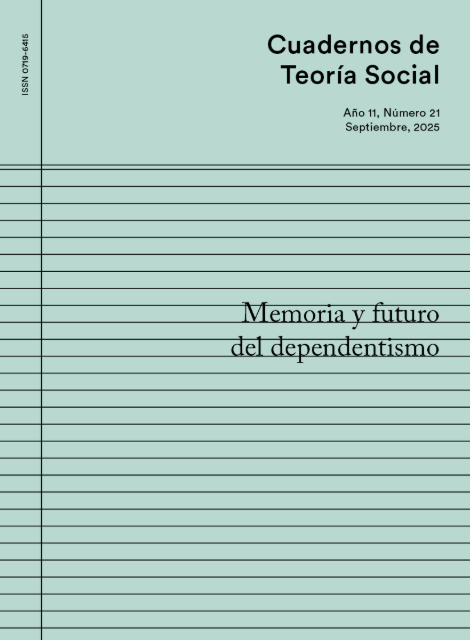
Really glad to have my Back to Dakar paper (originally published in Review of International Political Economy) with Felipe Antunes de Oliveira now published in Spanish in Cuadernos De Teoría Social. You can read it here. It’s part of a special issue on dependency theory edited by Martín Arboleda, Francisca Benítez & Alonso López.

Categories
Decolonizing Economics Heterodox Economics Publications

Decolonizing Economics – An Introduction (new book!)

We have finally published our book! It’s been a long-time coming and we’re excited to finally share it with the world. You can order it here. If you’re keen to write a review, let me know and I can ask Polity to send you a reviewer’s copy.

Here’s the blurb:

Decolonization has long been debated across the social sciences, but the economics discipline has so far avoided such critical engagement. This book provides a much-needed intervention.

Dutt, Alves, Kesar, and Kvangraven uncover the deeply Eurocentric foundations that shape how economists study the world today. These have rendered the discipline ill-equipped to tackle critical questions, such as structural racism, uneven development, the climate crisis, labour relations, and how structural power shapes economic outcomes. Decolonizing economics entails challenging the norms of neutrality and objectivity that economists claim to speak from, while fostering alternative ways of understanding the economy that take seriously structural power relations and contemporary processes of economic development. Readers will come to understand the political stakes of decolonization and the wide range of scholarship that already exists that can help us grasp economics from non-Eurocentric perspectives. Through such scholarship, we can gain an enriched understanding of capitalism and its relationship to exploitation, colonialism, and racialization.

And here are reviews of the book:

Reorienting the Economic Debate, by Robert Bigg, July 2025

Categories
Africa Critique of Mainstream Economics Decolonizing Economics Economic Development Ghana Imperialism Mining

New article: The Eurocentrism of mining in development economics

This new article in World Development interrogates how Eurocentrism is reflected in the Economics discipline’s approach to mining as well as in global mining policy. It then puts forward an alternative, South-centered understanding of mining, which is explored through a historical view of the Obuasi mine, which has been mined by AngloGold Ashanti in Ghana since 1897. The article is part of a special issue I’m co-editing on Decolonising Economic Development with Surbhi Kesar.

Categories
Decolonizing Economics Economic Development Publications

Decolonising economic development: the role of development sector (new report)

At a time when ‘decolonisation’ has become a buzzword in the international development industry and beyond, it is an opportune moment to assess what a decolonisation framework for the international non-governmental organisation (INGO) sector would entail. In this new report, Surbhi Kesar and I discuss what Eurocentrism is and how it can help us critically interrogate the role of INGOs in the development industry. You can read some reporting about our research here:

Categories
Critique of Mainstream Economics Decolonizing Economics Economics Nobel

The Colonial Origins of Economics (new commentary)

In response to the announcement of the Economics Nobel being awarded to Acemoglu, Johnson and Robinson (commonly referred to as “AJR”), I wrote a commentary for Economic and Political weekly with my co-authors Surbhi Kesar and Devika Dutt.

Here is the link to the piece and you can download the PDF for free here.

You can also read the piece in French, Persian and Portuguese.

Categories
Blog Decolonizing Economics

Decolonising Economics (new blog series)

Carolina Alves and I have recently launced a new blog series on Decolonising Economics on the Developing Economics blog. Have a look at our introduction and the contributions thus far here.

Categories
Africa Decolonizing Economics Economic Development

Reconfiguring African Studies, reconfiguring economics (new symposium)

I recently contributed to a very interesting symposium curated by Stefan Ouma and Christine Vogt-William: Reconfiguring African Studies, reconfiguring economics: centring intersectionality and social stratification in the journal Critical African Studies. It centered on a discussion of Franklin Obeng-Odoom’s book Property, Institutions and Social Stratification in Africa and includes contributions by Obeng-Odoom himself, the curators, Abena D. Oduro, Tanita J. Lewis, Lebohang Liepollo Pheko, Sara Stevano, and myself.