
It was great fun to discuss the big questions in development economics with Prof. Dan Banik on his podcast In Pursuit of Development. Listen to it and read more about it here.
Category: Economic Development
I had the pleasure and honour of debating ‘A New International Development Paradigm. Do the Sustainable Development Goals Drive Global Progress?’ with Dr. Fred Muhumuza (Makerere University) and Prof. Dr. Aram Ziai (University of Kassel) at the Online Summer Academy for Pluralist Economics, August 2020.
The blurb for the panel:
The Sustainable Development Goals (SDGs) of the United Nations are considered a universal benchmark for development around the world. But is it realistic to have such a benchmark for countries/regions whose societies are structured within different local contexts? During this discussion, the panelists will share their perspectives on what development is, on the relevance of the SDGs, and on what a new development paradigm could look like in light of the COVID-19 pandemic.

Along with D-Econ, I’ll be hosing a workshop at Exploring Economics’ Summer Academy August 10-16th 2020 on Critical Development Economics/Decolonizing Economics. Register for the workshop here.
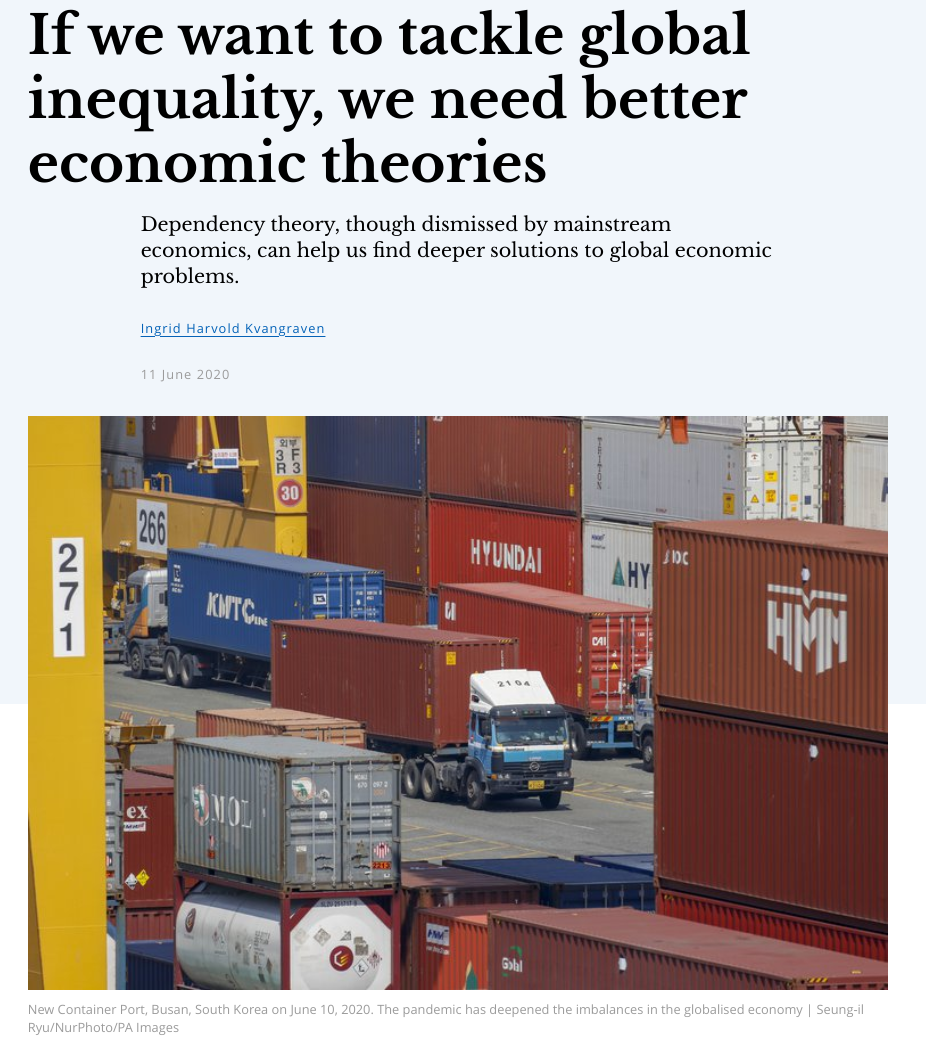
I wrote a post for openDemocracy laying out how a dependency theory research programme can help us understand the global impacts of COVID-19. Check it out.
I recently published “Beyond the Stereotype: Restating the Relevance of the Dependency Research Programme” in Development and Change. Here is the abstract:
This article evaluates the relevance of dependency theory for understanding contemporary development challenges, especially in the light of changes in the global economy over the past 50 years. In order to do so, the article rectifies previous misunderstandings of the scholarship and offers a new definition of dependency theory as a research programme, rather than a singular theory. Four core tenets of this research programme are identified: a global historical approach; theorizing of the polarizing tendencies of global capitalism; a focus on structures of production; and a focus on the specific constraints faced by peripheral economies. While each of these elements can be found in many contemporary theories, what makes dependency theory unique — and a particularly strong research programme — is the combination of these elements. The article demonstrates how this approach provides a deep and broad understanding that is necessary to appreciate the persistence of uneven development with reference to two case studies, namely successful industrialization in South Korea, and how the fragmentation of global value chains has impacted industrialization in Indonesia. Finally, the article argues that approaching these kinds of cases through a dependency research programme can contribute to a fruitful renewal of development studies.
You can read my twitter thread about the paper here.
I also wrote about the findings in the article in openDemocracy and Progress for Political Economy.

In April, I was interviewed for two episodes of the brilliant Danish Economics podcast Boblen. One episode was on microfinance and the other on trade.
With debate raging around the implications of COVID-19 for the “developing world”, Ingrid Kvangraven’s turn to guest curate the Cyberflâneur has come at the right time.[…] Ingrid has “chosen a selection of articles that can help us better understand how COVID-19 will impact developing countries and the underlying structures that lead to inequitable and underfunded health systems, with a focus on financialization and imperialism.” You’ll find some real gems, including on the “coloniality in knowledge production about public health”, why blended finance might not be as good as it sounds or how the IMF and World Bank have fed an audit culture “serving to obscure the destructive effects of NGO proliferation on public health systems”.
See the selection of articles with my comments here.
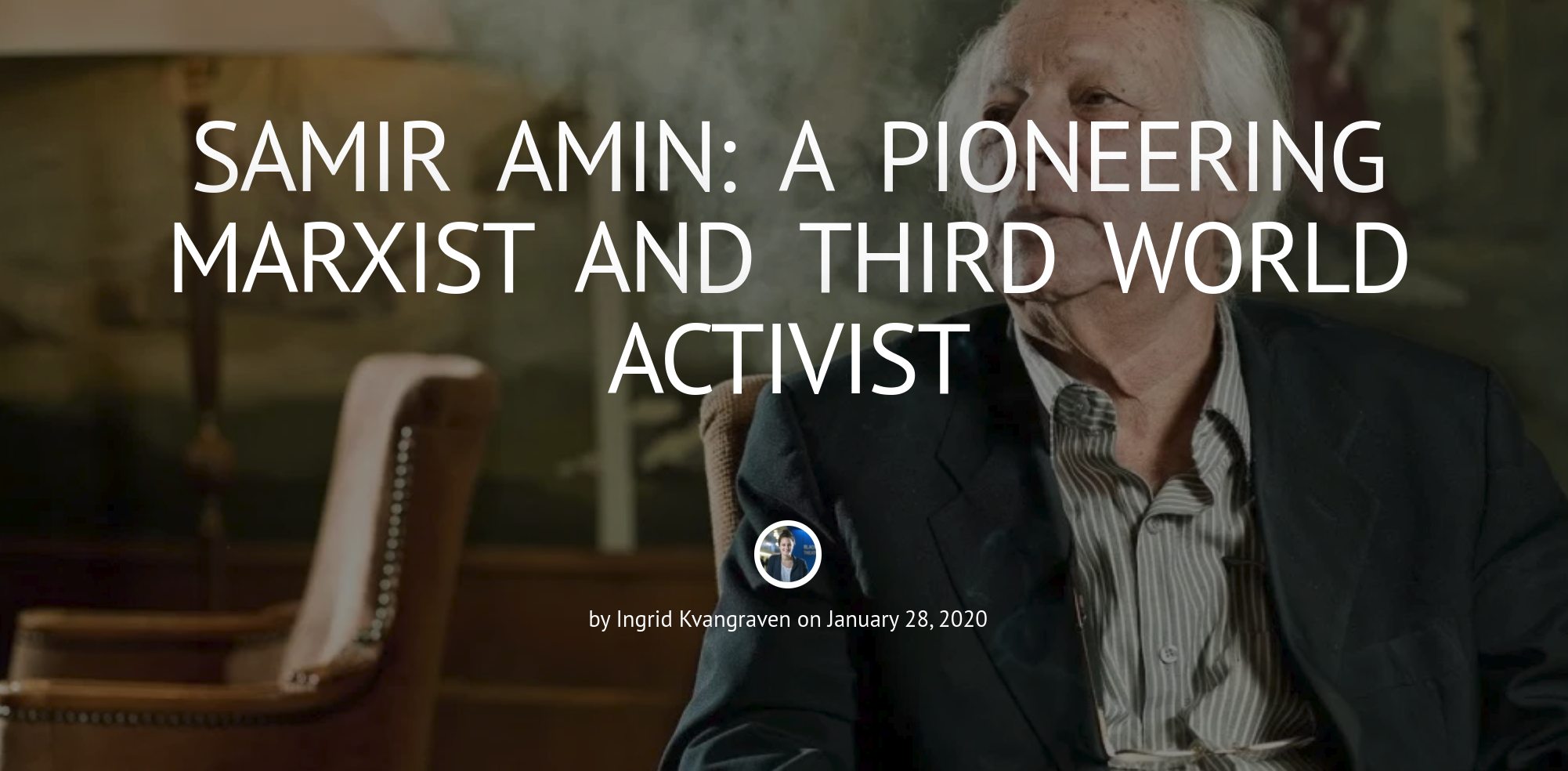
I recently had the pleasure of contributing a blog post to the excellent blog Progress in Political Economy (PPE), which is based at the University of Sydney’s Political Economy department. I wrote about Samir Amin’s legacy, based on my recent Legacy piece in Development and Change. Check it out here.
I wrote an essay for the World Development Symposium on Development and Poverty Alleviation. Here is the abstract:
This article situates the 2019 Sveriges Riksbank Prize in Economic Sciences in Memory of Alfred Nobel in the history of thought on development, tracing how the focus, theory and methods have shifted in the field. The article evaluates theoretical and methodological critiques of the way randomized control trials (RCTs) are employed by the laureates, as well as attempts to overcome these challenges. In terms of theory, the article demonstrates what gets lost when experiments are guided by methodological individualism and assumptions of individual utility-maximizing behavior. In terms of methodology, the article unpacks the limits of RCTs related to their causal model, and their lack of attention to human agency and wider socio-economic context. Finally, the article discusses the experimental approach’s relevance for research and policy-making and cautions against any approach becoming a “gold standard,” due to the importance of pluralism for maintaining an open debate about development.
Read the full article here and do check out the other essays as well.
I had the honor of writing a legacy piece on Samir Amin for Development and Change this year. It will be a part of the 2020 Forum issue, but is already available for download.

 Ingrid's website